Face

 Dentistry
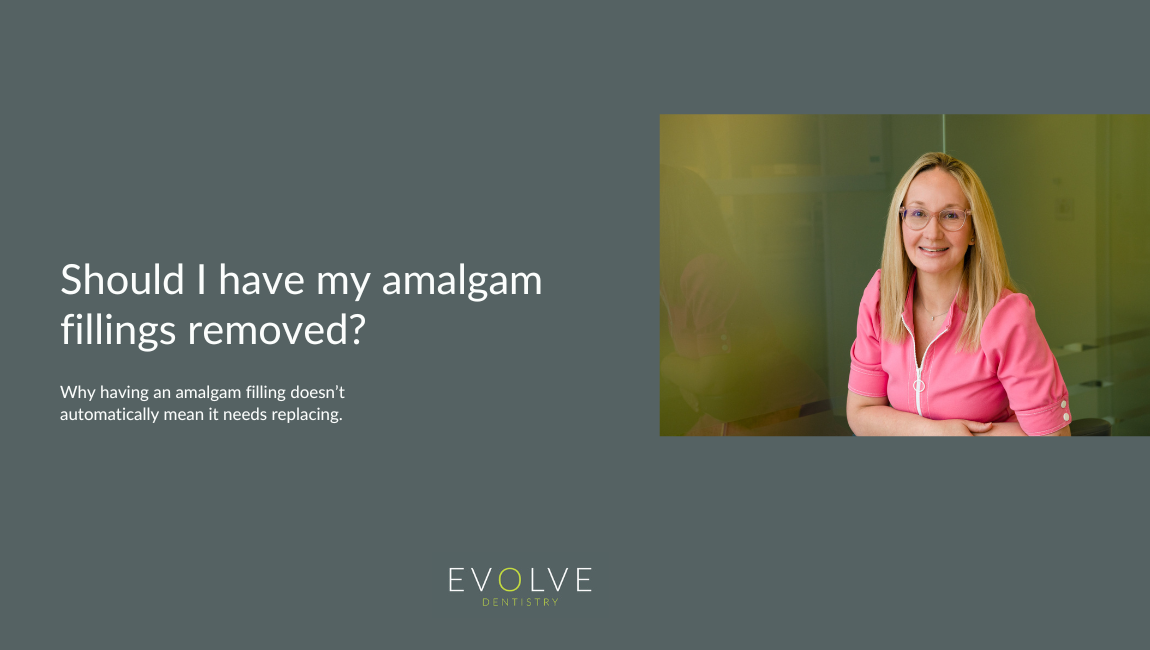
The short answer: No – amalgam fillings do not routinely need to be removed simply because they are amalgam. The right decision depends on the condition of the filling, the surrounding tooth and your individual reasons for considering treatment.
This is one of the most important questions we answer for patients considering amalgam removal.
It is also one where online information can make the decision unnecessarily difficult.
Some websites begin with the assumption that amalgam should be removed.
At Evolve Dentistry, we begin somewhere different:
Does this particular tooth actually need treatment?
Only once we understand that can we have a sensible conversation about removal.
Amalgam restorations, like all dental restorations, can eventually require further treatment.
There are several possible reasons.
A restoration may become damaged, fractured or otherwise require replacement.
This is not unique to amalgam. All restorative materials can eventually need maintenance or replacement.
Sometimes the issue is the tooth rather than the filling itself.
For example, further decay, damage or structural concerns may mean treatment is required.
Some heavily restored teeth eventually require more support than a direct filling can provide.
Depending on the amount of healthy tooth remaining, an inlay, onlay, crown or another restorative approach may be considered.
Some adults are perfectly happy with silver fillings.
Others become increasingly conscious of them, particularly if they are visible when laughing or opening their mouth.
If appearance is important to you, it is reasonable to ask whether replacement is possible.
That does not necessarily mean treatment is clinically required.
It means we can discuss the potential aesthetic benefit alongside the implications of removing a functioning restoration.
Age alone does not tell us whether a restoration needs replacing.
Some amalgam fillings have been present for many years and remain serviceable.
Rather than using a fixed age at which fillings should be replaced, we assess the individual restoration and surrounding tooth.
This may include looking at:
An older filling deserves monitoring.
It does not automatically deserve drilling.
Pain is not the only reason a tooth might need treatment, but the absence of pain is still useful information.
Some dental problems can be identified before they become painful.
Conversely, the fact that a filling has been present for a long time without symptoms does not by itself tell us whether it should stay or go.
This is why examination matters.
We combine what you tell us with what we can see clinically and, where appropriate, what appears on dental X-rays.
This is where we need to be particularly careful.
Amalgam contains mercury as part of a mixture of metals, and this understandably leads some patients to research the subject.
However, we do not recommend removing a sound amalgam filling on the basis that doing so will improve your general health.
We also do not make claims that removing amalgam treats fatigue, headaches, immune conditions, neurological symptoms or other general health concerns.
If online information has made you worried, you are welcome to discuss those concerns with us.
Our role is to assess your teeth, explain your dental options and help you separate clinical decisions from unsupported claims.
That is a different conversation.
Dental appearance matters differently to different people.
If you have a visible silver-coloured restoration that bothers you, you can ask whether a tooth-coloured replacement is possible.
The key consideration is that replacing a functioning restoration still requires treatment of the tooth.
Before you decide, Carol or Maggie can explain:
You can then decide whether the cosmetic benefit is worthwhile for you.
Because dentistry should not involve treating healthy or serviceable teeth without good reason.
If you have six amalgam restorations and two require treatment, that does not automatically mean all six should be removed.
Each tooth should be considered individually.
You may end up with a plan that says:
That is often more useful than a blanket “remove them all” approach.
SMART stands for Safe Mercury Amalgam Removal Technique.
It describes additional precautions used when an amalgam restoration is being removed.
It does not provide the reason for removal.
The sequence should therefore be:
Does the tooth or restoration need treatment, or do I have another informed reason for considering replacement?
If removal goes ahead, how will the amalgam be removed?
At Evolve, SMART can be used as part of that second stage.
If you are unsure what to do, work through these questions.
Has your dentist identified an issue with the restoration or tooth?
If yes: understand what the problem is and why treatment is recommended.
If no: move to question two.
Would changing the silver-coloured restoration make a meaningful cosmetic difference to you?
If yes: discuss whether elective replacement is sensible for that particular tooth.
If no: monitoring may remain an option.
Before agreeing to removal, understand how the tooth will be restored afterwards.
This is an important question.
If monitoring is a reasonable alternative, you should know that.
If you decide to proceed, ask about the SMART protocol, appointment length, comfort, aftercare and cost.
Reality: All restorations require monitoring, but there is no blanket rule that every amalgam restoration should be removed simply because it exists.
Reality: Restoration age is only one consideration. The condition of the tooth and filling is more important.
Reality: Evolve does not recommend removal on the basis that it will improve general health and does not make claims that amalgam removal treats medical symptoms.
Reality: Dental examinations can identify problems before complete restoration failure. If treatment is required, it can be planned appropriately.
Reality: Patients are allowed to care about how their teeth look. Cosmetic replacement can be discussed, but you should understand the implications of treating a functioning tooth before deciding.
Carol or Maggie will first listen to why you are considering amalgam removal.
They can then examine your restorations and surrounding teeth.
Where clinically appropriate, assessment may include dental X-rays.
The aim is to establish:
An assessment does not commit you to removal.
Not automatically. Each tooth and restoration should be assessed individually.
You can discuss elective replacement with your dentist, including cosmetic reasons. Whether treatment is appropriate depends on the tooth and your individual circumstances.
No restorative material is automatically best for every tooth. The appropriate option depends on the amount of remaining tooth, the position of the tooth and other clinical factors.
No. SMART relates to how an amalgam restoration is removed if treatment is going ahead. It does not mean Evolve recommends routine removal of sound fillings.
If the restoration is serviceable, monitoring it during your normal dental care may be entirely appropriate.
What is SMART amalgam removal?
Understand the protocol itself.
Is it safe to remove amalgam fillings?
Explore the considerations involved in the removal procedure.
What can replace an amalgam filling?
Understand the restorative options available afterwards.
Or return to:
Amalgam removal using the SMART protocol – our complete patient resource
Your guide to SMART amalgam removal brings the entire decision-making process together in one place.
Download it to read in your own time or bring your questions to your consultation.
If you’re thinking about having your amalgam fillings removed, the first step is to understand your options. At Evolve Dentistry in Portishead, we can assess your existing fillings, discuss your concerns and explain the potential benefits, risks and alternatives.
We offer amalgam removal using the SMART protocol, with precautions intended to reduce exposure to mercury vapour and particles during the procedure.
Find out more about amalgam removal at Evolve Dentistry.
Carol or Maggie can examine your existing restorations and explain whether treatment or monitoring may be appropriate.
You do not need to arrive having decided to remove anything.
For general information about fillings and restorative dental treatment, visit the NHS:



💚 WE’RE HIRING! Join our award-winning team! 💚
Patient Care Advisor | Evolve Dentistry, Portishead
We’re not just looking for someone to answer the phone and book appointments.
We’re looking for someone who LOVES people, takes pride in making others feel welcome and believes that exceptional customer service is all about the little things. ✨
At Evolve Dentistry, our Patient Care Advisors are at the heart of everything we do. From the first friendly hello to helping patients feel comfortable and cared for, you’ll play a huge part in creating the experience we’re so proud of.
And the best bit? You don’t need dental experience!
If you’ve worked in hospitality, customer service, reception or another people-focused role, we’d love to hear from you.
💚 What we’re offering:
✨ £14.50–£17.50 per hour, depending on experience
✨ A supportive, award-winning team
✨ A beautiful, modern working environment
✨ Training and development opportunities
✨ Staff dental discounts
✨ Team socials and celebrations
✨ A workplace where you’re genuinely valued
📅 Working hours:
Tuesday afternoons, Wednesdays, Thursdays and one Saturday per month.
We’re looking for someone who’s warm, organised, confident, positive and passionate about making a difference to people’s day.
Sound like you? We’d love to meet you!
📩 Email hello@evolve-dentistry.co.uk to request an application pack.
⏰ Applications close Friday 30 October 2026.
💚 Know someone who’d be perfect for our team? Tag them below or share this post with them!
#EvolveDentistry #WereHiring #PortisheadJobs #NorthSomersetJobs #DentalCareers #PatientCare #JoinOurTeam

If you’re considering replacing an amalgam filling, you may have come across the term SMART.
SMART stands for Safe Mercury Amalgam Removal Technique. It is a protocol designed to reduce exposure to mercury vapour and particles while an amalgam filling is being removed.
At Evolve, SMART amalgam removal is available for adults who have made an informed decision to replace their amalgam fillings.
Importantly, we don’t suggest that everyone should have their amalgam fillings removed, and we don’t make claims that removing them will improve your general health.
Swipe through for a simple explanation of what the SMART approach involves.
#SMARTAmalgamRemoval #AmalgamFillings #DentalCare #EvolveDentistry
If you’ve never visited Evolve before, here’s a little look around.
We know that walking into a new dental practice can feel daunting, particularly if it’s been a while since your last appointment.
We’ve designed Evolve to feel calm, welcoming and a little different from what you might expect from a dental practice.
But the most important part isn’t the building. It’s how you’re made to feel when you’re here.
Come in, make yourself comfortable in our patient lounge and let us look after you.
#EvolveDentistry #Portishead #PortisheadDentist #DentalCare
Gum disease can be surprisingly easy to overlook.
Bleeding when you brush, red or swollen gums, persistent bad breath or gums that seem to be receding are all things worth paying attention to.
The important thing is not to wait until something hurts. Gum disease can develop without causing pain, which is one reason regular dental and hygiene appointments matter.
In this short video, Yasmin explains some of the signs to look out for.
If you’ve noticed a change in your gums, mention it at your next appointment or get in touch with the team.
#GumHealth #DentalHealth #PreventiveDentistry #EvolveDentistry
🦷 Day one, first clinic!
Carol has sent us the first photos from her trip — and what a first day it’s been!
Working alongside five other dentists, the team saw an incredible 197 patients in just one day. ❤️
In Carol’s words:
“I’ve taken out more teeth today than I have in the past year!”
A very different day in dentistry from the ones Carol is used to back home at Evolve, and a reminder of just how much need there is for the care the team is providing.
We’re so proud of her — and we’ll be sharing more updates and photos from Carol’s trip as they come in. 🌍🦷
#EvolveDentistry #DentalOutreach #Dentistry #MakingADifference
Ever run your tongue over your teeth and wonder why they suddenly feel rough?
There are a few possible reasons, from plaque build-up to changes in the surface of a tooth.
In this short video, Yasmin explains some of the common causes and when it’s worth mentioning it to your dentist.
Noticing small changes in your mouth is useful. You don’t need to diagnose them yourself, but do tell us if something feels different.
#DentalHealth #OralHealth #Portishead #EvolveDentistry

 BannerText_Seraphinite Accelerator