Face
Face 
 Dentistry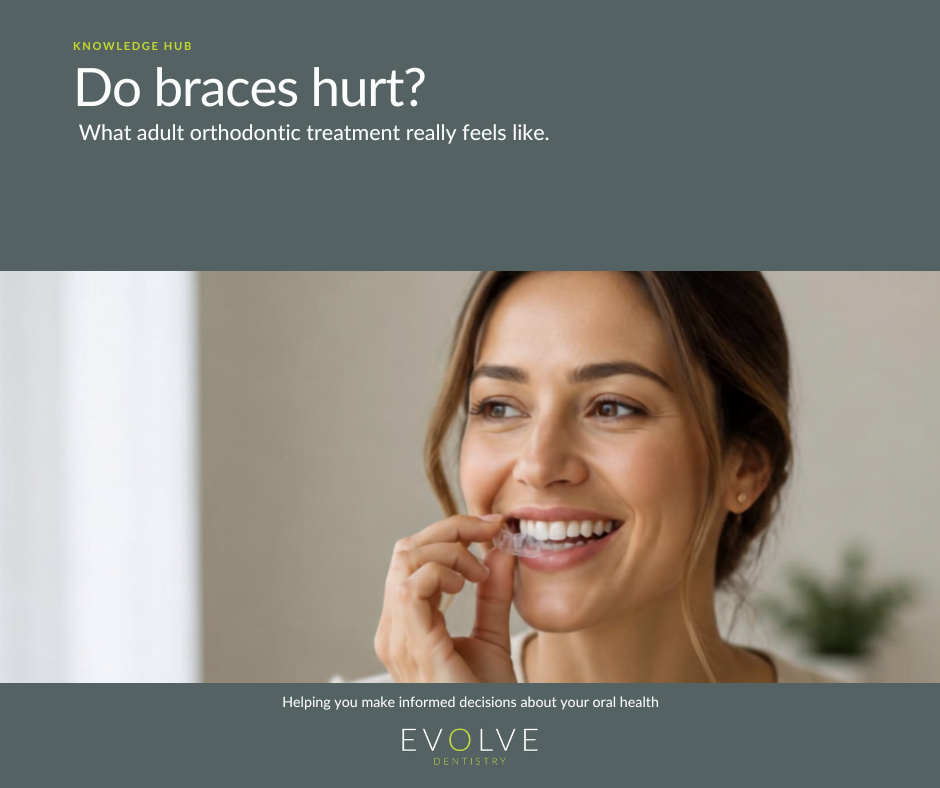
If you’re wondering “Do braces hurt?”, you’re not alone. It’s one of the most common questions adults ask before starting orthodontic treatment.
The good news is that while braces can cause some temporary discomfort as your teeth begin to move, most people describe the sensation as pressure or tenderness rather than pain.
If you’re considering adult braces, understanding what to expect can make the whole experience feel much less daunting.
One of the biggest concerns we hear is:
Many adults imagine sore teeth, emergency appointments and months of discomfort.
Usually, that’s because of stories they’ve heard from friends or memories of someone they knew having braces years ago.
Modern orthodontic treatment is very different.
Today’s appliances are smaller, treatment planning is more precise and the experience is often much easier than people expect.
That doesn’t mean you’ll feel nothing.
It simply means most people experience a short period of adjustment rather than ongoing pain.
Although people often ask “Do braces hurt?”, most patients describe the sensation very differently.
Common descriptions include:
It’s rarely described as sharp pain.
Instead, it’s similar to how muscles feel after exercise—slightly tender because they’re adapting to change.
Your braces are applying gentle, controlled forces that gradually move your teeth into healthier positions.
If you’re asking “Do braces hurt?”, it’s helpful to know that any discomfort usually happens at predictable times.
The first few days are when braces are most noticeable.
As your teeth begin responding to gentle pressure, you may notice tenderness when biting or chewing.
For most people, this settles within a few days.
Each time your braces are adjusted—or you move to a new set of clear aligners—you may experience a similar feeling of pressure.
Again, this is usually mild and temporary.
Fixed braces can occasionally rub against your lips or cheeks while your mouth adapts.
Orthodontic wax often helps during this settling-in period.
If something feels unusually uncomfortable, we’d always encourage you to contact us.
One of the biggest mistakes we could make is saying braces don’t hurt at all.
That wouldn’t be honest.
A better answer to the question “Do braces hurt?” is that most adults experience a little tenderness during the first few days after fitting or adjustments—but it’s usually far less uncomfortable than they expected.
Knowing what to expect often removes much of the anxiety before treatment even begins.
Many adults ask whether clear aligners hurt less than fixed braces.
Both treatments work by applying gentle pressure to move your teeth safely.
With clear aligners, you may notice pressure each time you change aligners.
With fixed braces, you may notice similar tenderness after adjustments.
Rather than focusing on whether braces hurt, it’s more helpful to choose the appliance that’s most suitable for your smile and treatment goals.
If your teeth feel tender after your braces are fitted or adjusted, simple measures are usually all that’s needed.
You may find it helpful to:
You should never feel you simply have to “put up with it.”
If you’re concerned, we’d always rather you ask.
Most people notice gentle pressure or tenderness during the first few days after their braces are fitted, but this usually settles quickly.
You may notice some temporary pressure after review appointments, but most patients find this mild and short-lived.
Clear aligners can also create a feeling of pressure when changing to a new aligner, although this usually settles within a couple of days.
Our complete guide explains every stage of treatment, including what to expect during the first few days, how to live comfortably with braces and how to protect your smile once treatment is complete.
Download The Evolve Guide to Adult Braces
Read our CQC report



Clear aligners or fixed braces - which is better?
Which is better - clear aligners or fixed braces?
Neither.
At least, not until we know more about you.
The right orthodontic treatment depends on your teeth, what you`d like to change, your lifestyle and a number of clinical considerations.
For some people, clear aligners can be a great option. For others, fixed braces may be more appropriate.
So rather than starting with:
“Which braces do you want?”
We`d much rather start with:
“What would you like to change about your smile?”
Swipe through to understand some of the differences.

💚 £338 raised for Macmillan Cancer Support! 💚
We had such a lovely time at our Macmillan Coffee Morning last week. ☕🍰
A huge thank you to everyone who popped into the practice, enjoyed a slice of cake, had a chat and made a donation. It was wonderful to see so many of our patients, friends and members of the local community getting involved, and we were genuinely touched by everyone’s generosity.
Together, you helped us raise an amazing £169.
And we’re delighted to share that Carol has very generously matched every pound raised, bringing our final total to…
🥁 £338 for Macmillan Cancer Support! 💚
Thank you to our brilliant team for baking, organising and keeping the cake table well stocked, and to every single person who helped make the day such an enjoyable one.
Days like this remind us just how lovely the community around Evolve really is. 💚
#MacmillanCoffeeMorning #MacmillanCancerSupport #Portishead #EvolveDentistry #PortisheadCommunity
Being shortlisted for Team of the Year means a lot to us, but not because of the trophy.
It’s because dentistry is never the work of one person.
It’s the nurse who notices you’re nervous before you’ve said a word. The reception team member who remembers the conversation you had last time. The clinician who takes time to explain something again. The person behind the scenes making sure your visit runs smoothly.
Those small things happen every day at Evolve, and they only happen because people care about the experience we create together.
So being a finalist gives us a lovely excuse to say something we probably don’t say often enough: we’re incredibly proud of this team.
#PrivateDentistryAwards #TeamOfTheYear #DentalTeam #EvolveDentistry
You might notice a familiar face missing from Evolve for a little while… 💚
Carol is heading to Zambia with SmileStar, a dental charity providing free dental care to communities with limited access to treatment.
In this video, Carol shares a little more about where she’s going, what she’ll be doing while she’s there and why she wanted to be part of the trip.
It’s going to be a very different couple of weeks away from the practice, and we’re incredibly proud to see Carol giving her time and skills to support SmileStar’s work.
We’ll be sharing a little more from her trip when we can, but for now, we’ll let Carol tell you all about it in her own words. 💚
Safe travels, Carol. We can’t wait to hear all about it when you’re home!
#EvolveDentistry #SmileStar #Zambia #Dentistry #Portishead
🍰 Come and join us today! 💚
Our Macmillan Coffee Morning is in full swing at Evolve Dentistry, and we’d love to see you!
We’ve got plenty of delicious homemade cakes waiting for you, so pop in, say hello, grab a slice (or two!) and help us raise money for Macmillan Cancer Support.
We’ll be serving cakes right through until 5pm today, so there’s still plenty of time to come down.
📍 Evolve Dentistry, Portishead
🍰 Cakes until 5pm
💚 Everyone is welcome
Come hungry! 😋
#MacmillanCoffeeMorning #MacmillanCancerSupport #Portishead #PortisheadCommunity #EvolveDentistry
🍰☕ Today’s the day - and there’s cake! 💚
Our Macmillan Coffee Morning is happening TODAY at Evolve Dentistry and we’d love you to come and join us.
The Evolve team have been busy baking (and possibly buying… we won’t judge! 😉) and there’ll be plenty of cake and drinks available throughout the day, all in support of Macmillan Cancer Support.
And remember - you don’t need to be an Evolve patient to come along.
If you live or work in Portishead, are passing by, or just fancy an excellent excuse for cake, pop in and see us. Bring a friend, your family or your workmates too!
📍 Evolve Dentistry, Portishead
🍰 Cake and drinks throughout the day
💚 Donations for Macmillan Cancer Support
👋 Everyone welcome
No appointment needed - just pop in!
Come and help us eat an unreasonable amount of cake for a very good cause. 💚
Please share so we can get as many people through the doors as possible!

 BannerText_Seraphinite Accelerator